Friday, December 02, 2005

More camo

students in green
teachers in pink

“Camo Day” photos (more)

A second collection of odds and ends from the camouflaged world (part one is here, although you can likely scroll down the page a little to see it).

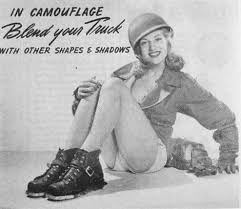
First up is the popularity in American secondary schools of “Camo Day,” where students and teachers dress appropriately [inset left]. Any Camo Day googling will quickly uncover a story on the Spurger [Texas] school that was flummoxed by a parent’s worry on the effect of a school tradition similar to Sadie Hawkins Day (where girls take the initiative in asking out boys): at Spurger, though, the boys often wore skirts or dresses for their celebration, raising a concern that the practice might lead to more widespread homosexuality. The school district cancelled the rite last year, replacing it with the manlier wearing of the ’flage.

separator
Camo Madonna and Child

In the late 1970s, French architect and artist Émile Aillaud imposed a camouflage pattern on seventeen high-rise buildings—the Cloud Towers [“Tours Nuages”], found in the Paris suburbs at Nanterre.

separator

Scottish artist Ian Hamilton Finlay has long employed camouflage in works investigating Western pastoralism and the theme of death in arcadia.

separator

Reprinted here: several anecdotes from Patrick Wright’s review of DPM: Disruptive Pattern Material in the London Review of Books on the part of fine artists in the development of camouflage.

“I well remember at the beginning of the war,” Gertrude Stein wrote in 1938, “being with Picasso on the Boulevard Raspail when the first camouflaged truck passed. It was at night, we had heard of camouflage but we had not seen it and Picasso, amazed, looked at it and then cried out, yes it is we who made it, that is Cubism.” Stein went on to suggest that the entire First World War had been an exercise in Cubism. Hailing Picasso as the first to register an epoch-making change in the “composition” of the world, she concluded that a great convulsion had been necessary to awaken the masses to his discovery: “Wars are only a means of publicizing the thing already accomplished.”

separator
Spandex-Vneck-tee
Woodland-Camo-Tee

From Camoshop.net

Abbott Thayer (1849-1921), the “father of camouflage,” American portraitist and landscape artist, was well known for his “angel” paintings, in which he added feathery white wings to portraits of girls and young women. In 1915, the painter was due to meet army authorities in London in order to exhibit a prototype camouflaged garment for snipers. Thayer, who was suffering from nervous tension at the time and was probably also fed up with being mocked and derided, pulled out of the meeting at short notice, leaving John Singer Sargent to attend on his own. The British generals are said to have been horrified when Sargent opened Thayer’s valise. According to Richard Murray of the Smithsonian American Art Museum, the prototype garment resembled an old hunting jacket, trailing strips of coloured cloth and daubed with patches of colour that reflected Thayer’s interest in harlequin costumes. It’s not clear whether the British generals objected to the scruffiness, the disruptive coloration or the cowardice that some military traditionalists still believed was at the root of the camoufleur’s new systems of deception.
separator
Chili 1
Chili 8
Chili 5
Chili 4

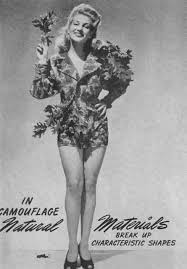
Chili Williams
WWII camo posters

The British artist Solomon J. Solomon (1860-1927) and his colleagues came up with a grass-threaded fishing net, which would, he claimed, quickly become the “universal camouflage” material for French as well as British troops. Assisted by a carefully chosen band of scene painters from Covent Garden and the Drury Lane Theatre, Solomon also produced steel-cored observation posts that resembled slender willow trees. Other effects were achieved with wire-netting, dyed raffia, papier-mâché and plaster of Paris, the last proving especially useful in the construction of dummy heads that could be pushed up over a trench parapet to tempt enemy snipers into revealing their positions. Later, he worked at the secret Elveden Explosives Area in Suffolk, devising schemes that would enable Britain’s new tanks—which would later be dubbed “Cubist slugs”—to blend into the landscape. Solomon was repeatedly frustrated by the attitudes of the military command. He was mockingly addressed as “Mr. Artist” when he visited GHQ in France, and felt blocked in his attempts to ascertain the terrain in which tanks were likely to be deployed. The trainee tank soldiers appear to have remembered his designs not so much as Cubist attempts to confound enemy observers, but as ludicrous “pink sunsets” that would soon disappear under the flying mud of the Western Front.

separator

The camouflage sections had enjoyed moments of popular acclaim on the Home Front. During the war bond campaign, Trafalgar Square was briefly turned into a “camouflaged” village, and a shop in Hackney’s Mare Street drew considerable attention when decked out as a camouflaged trench.

Labels:

Friday, November 18, 2005

City of lights

'Evening in Paris' perfume
Ads from the 1950s:
0 1 2 3 4

Crikey. I’ve been working long hours this week, and haven't gotten enough downtime to polish off the longer pieces that have been in the hopper for too long already, but a few short notes ere I fly to Nashville this eve.

Cindy passed along the following from Stumps, a company that specializes in products for planning proms and other similar events. In the 1940s, they offered “Evening in Paris,” the first large area decorating theme kit. Well, they’ve expanded hugely since then, and the endless catalog of theme kits is a sight to behold.

Midnight in Paris

My favorite is the “Midnight in Paris,” and now my mind is spinning to find a reason to buy one of these things. From the description, the kit contains

1 Paris Gate, 1 La Tour Eiffel, 1 Paris Skyline, 1 Set of Parisian Hedges, 1 Pair of La Tour Lamp Posts, 1 Set of La Tour Mini Lamp Posts. We created the background with black and gold star gossamer. We created the floor with dark green and cobblestone flat paper.

À bientôt, y’all!

Labels: ,

Friday, November 11, 2005

Camouflage survey

It all started with a great score from Daedalus, a book I’ve been looking for for some time: designer Hardy Blechman’s Disruptive Pattern Material: An Encyclopedia Of Camouflage (Firefly, 2004—it had previously been available only under a British imprint) for a cool $30—go and check it out at the source, or see Steven Heller’s review in Eye, or the one in Boldtype.

And then, in rapid succession: a BB post on dazzle camouflage, followed by a call for papers for the upcoming Camouflage: Art, Science and Popular Culture, to be held at the University of Northern Iowa Department of Art on Saturday, 22 April 2006. (The conference is organized by Roy R. Behrens, whose False Colors: Art, Design and Modern Camouflage—Bobolink, 2002—is the wonky yang to Blechman’s stylish yin; proposals are due by 10 January 2006.)

dazzle Fiat Strada
A dazzly paint-job.

Some snips: in 1917, at the height of the U-boat scare during WWI, a former marine artist, designer, and illustrator—one Lt. Cdr. Norman Wilkinson of the Royal Navy—was assigned to a team tasked with visually altering British ships to improve maritime survivability. Interestingly, dazzle (as it came to be known) did not operate as conventional camouflage—which typically masks a body’s visibility—usually does: dazzle creates a vibrating visual field which makes it difficult for a human observer to accurately determine the position and heading of a potential target, crucial inputs for a successful torpedo-er (prior to the age of radar, sonar, and computerized navigation). Wilkinson’s band tested candidates by painting models and testing their effectiveness by rigging a turntable, water, and periscope optics. (The U.S. and France would follow suit, usually employing fine artists in the endeavor.)

DPM is a rich visual sourcebook, one that gets you heading in all sorts of fruitful directions: it covers camouflage in the natural world, in warfare (of course), but also provides fashion and pop images that serve as great fodder for free-association. Me? I’ve been pondering the morphing of camo from utilitarian to semiotic signal of the military, patriotism, and plainspeaking Americanism (in our fair city, football fans have adopted the uniform, with a bit of tailoring). And in the Costume Institute’s Extreme Beauty: The Body Transformed (from 2001), one thread concerned the utility of fashion in hiding unflattering body parts.

For the scholars: a camouflage bibliography, courtesy of Behrens.

Venus de Milo
Venus de Milo
Eva Green as Venus de Milo
Eva Green in
The Dreamers

Addendum: From a scene in Bernardo Bertolucci’s awkward and forced Dreamers, actress Eva Green is depicted as the Venus de Milo when she camouflages her arms by wearing long black gloves and standing in a dark doorway, dressed only in drapery surrounding the hips. [cws::13 Nov]

Labels: , , ,

Friday, July 08, 2005

Earthworks

Tyler has posted from the Lightning Field, almost a year to the day I visited last summer. He notes, among many other observations, that

Looking at Lightning Field was like looking at a painting. When my eyes found one pole, it led me to the next one. The poles moved my eye around the landscape the way the discovery of objects, cats, and people in a Bonnard move my eye around the canvas.

and

I found the Lightning Field neither meditative nor introspective. When I looked at it, I thought about the field and the way my eyes moved around it, not about myself.

I felt a tension between the movement he describes, a restlessness that bothered me intermittently—I was constantly distracted by the regular patterns, the alignments of the gridded rods, unavoidable correspondencess for those with mathematical minds, and I didn’t care for the mania it sometimes evoked.

Lightning Field
(Courtesy of MAN)

Yet, as we know, in the best earthworks the land does keep one grounded, so to speak; I tried to convey a bit of the power that the land carries in the west in my [admittedly abstract] essay on place and Los Angeles, a power to still one’s mind and to facilitate harmony with one’s surroundings, with oneself. Tyler remarks that

Land art is not about the hubris of the artist who places an object in the landscape in an attempt to draw the eye away from nature. It is about being modest, about being willing to have your art dwarfed by the earth.

I’d go a step further: land art is, in part, about the modesty of the viewer himself (or herself), a measure of the willingness of the audience to be dwarfed by the earth. Insofar as the Lightning Field interferes with the ability to experience this modesty, it fails where Heizer, Turrell, and Serra do not.

Finally, it is noteworthy to comment upon the social aspect of the work: the Lightning Field is experienced in a small group, numbering six or so, and for twenty-four hours. It is often the case that viewers experience the work, in part, with someone who they aren’t well-acquainted with, and this engenders a kind of social modesty. Furthermore, the act of discovering the Field [a process described in some detail in the MAN post] is mirrored in the dance of intimacy shared among the cabin-dwellers: a few days after leaving Quemado, I discovered that one of the folks who stayed with us in the cabin was a MacArthur fellow.

Labels:

Tuesday, July 05, 2005

Pink

iPod mini


Paul Simenon of the Clash once said to me, “Pink is the only true rock ’n’ roll color.” Apparently, they painted all their equipment pink for a tour.


—Luella Bartley, as told to BlackBook, in their spring 2005 issue.

Labels: ,

Friday, June 10, 2005

Heat index

The picture at the right, below,
Roadside igloo
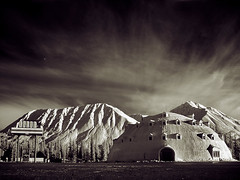
Igloo City, Cantwell, Alaska.
Courtesy of flickr;
originally uploaded by Mr. Lunatic Fringe.
an arty snap of an igloo-hotel-in progress near Cantwell, Alaska, made the rounds the other day (I first saw it on Coudal’s website).

Here, ff is providing a full-on collection of igloo links—not a lame one among them—to celebrate the onset of summer weather on the eastern seaboard.

The neon eskimo hovering over the two metal domes of the drive-in invited passengers from a distance. Irene’s uniform, which included a short red skirt, red panties, white short-heeled boots, and white jacket, probably attracted more customers.

Correction: I had originally cited BB as my initial sighting; changed it to Coudal, where I really saw it (sorry, Phil!). [cws::28 Jun]

Labels:

Thursday, May 05, 2005

Oh, dear: Crabtown

lit map inset

Artist: Ron Roos
Title: An Udderly Unique Maryland Species, sponsored by Linehan Family Foundation, Inc.
Description: A white crab with black, Holstein cow markings on front and back. Its back is includes an inscription about agriculture and the health of the Bay.

Crabtown central; more submissions from the Baltimore City website.

Labels: ,

Thursday, April 21, 2005

Mao Zedong is the red sun in our hearts!

Factory 798 (warning: extremely ill-behaved and not very informative website; highlights are this photo of the unimproved gallery space and this one of the finished lounge) was once a military electronics factory, built in the 1950s by East German advisors to the young PRC.
Factory 798 exhibition space detail
(Originally uploaded by Roy.)
It's now a Bauhaus white elephant—still sporting communist slogans, e.g., the titular mention—reborn as an arts center, yet running for its life from developers seduced by the 2008 Beijing olympiad.

[In the meantime, check out Gridskipper on Beijing travel and Hou Hai Lake, another hipster locus.]

Labels:

Tuesday, April 19, 2005

Islamic graveyards

Don Milstead, my high school teacher in American history, used to explain how he always visited graveyards when travelling; now, I do the same—on my way to Maryland's eastern shore, or in Los Angeles, or Paris, and in the Muslim world, too.

Süleymaniye cemetery
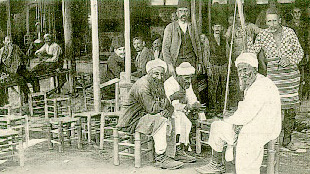
Old Ottoman cemeteries—the grounds of the Süleymaniye mosque in Istanbul—have headstones decorated with headgear that the man wore during his life on earth (in premodern times, at least): one frequently sees fezzes or turbans atop the tall, vertical pillars that mark the gravesite, or flowers and sea shells for the graves of women.

City of the Dead Cairo

The graveyards I have visited in north Africa and the middle east are exotic and often beautiful to my Western eyes, but none are as striking as the medieval cemetery in downtown Cairo known throughout the West as the City of the Dead. When I first laid eyes on the CotD, its monochromatic duskiness piqued my interest immediately; the "northern cemeteries"—once outside the city (as is traditional in Islamic societies) but long ago overtaken by nearly 20m residents—is a shantytown where living Cairenes coexist with the interred. It's a fascinating place with a culture all its own, and is as important to visit as the pyramids.

Excerpted images from two slide shows (here and here) on the City of the Dead may be found here (0 1 2) and here (0 1 2 3 4).

Labels: , , , , ,

Thursday, April 14, 2005

Unbuilt Moscow

From the 1930s to the early 1950s: Unrealised projects in Muscovite architecture; Aeroflot Building [above], D. Chechulin (1934). [via Design Observer]

Labels: , , ,

Tuesday, April 12, 2005

Pebbles

Clockwise from top left:

Labels: ,